Plain Terms·Distribution
Google Finally Started Burying the Junk. About Time
Google now treats mass-produced pages as spam no matter who, or what, wrote them. If your plan was a thousand AI pages, you are the target. If you answer the question, you are the point.

John Bymori · · 4 min
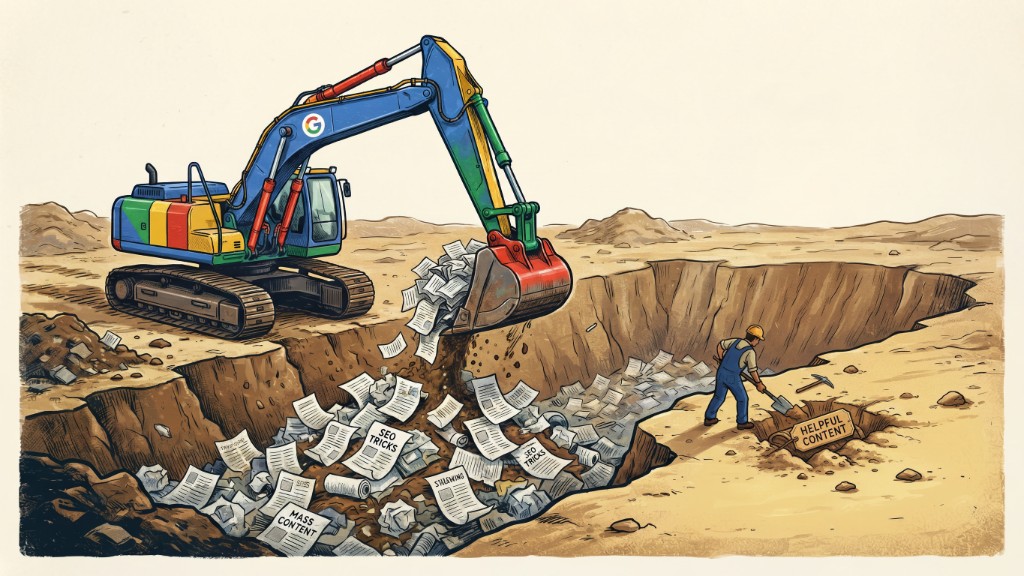
Everyone has scrolled past a life story to reach a recipe. Everyone has clicked a result that promised an answer, found three paragraphs restating the question, and hit back. Those pages were not written for you. They were written for a search engine. Google has said, in its own words, that it is coming for them.
01What changed
Google cut low-quality results by 45%.
On March 5, 2024, Google announced a core update aimed at pages that "feel like they were created for search engines instead of people." It expected a 40% drop in low-quality, unoriginal content in results. When the rollout finished on April 19, Google said the drop was 45%.
The same day, it added three spam policies. One, scaled content abuse, is the one that matters for anyone building with AI.
02The new rule
It does not matter who wrote it. It matters why.
Google defines scaled content abuse as many pages "generated for the primary purpose of manipulating search rankings and not helping users," and applies it "no matter how it's created": by people, by AI, or both. Its own examples include using generative AI "to generate many pages without adding value for users," and stitching other sites together.
Its announcement named the exact page everyone hates: one that pretends "to have answers to popular searches but fail[s] to deliver helpful content."
03Why we are glad
The web got buried, and builders did the burying.
This is the right call, and builders should say so instead of mourning a loophole. Cheap page generators turned search into a landfill. Every useful answer competed with a hundred machine-made copies of nothing.
There is a catch for small builders. Google said the update could hit "sites created primarily to match very specific search queries." Matching the query is not the offense. Failing to answer it is. A page that matches a question and fully answers it is exactly what a search engine exists to find.
04What to do next
Build one page that answers. Delete the rest.
Ask of every page you publish: would a person be glad they landed here, even if search did not exist? If not, take it down. One page with a working tool, a sourced number, or a real judgment beats a hundred that only restate the question.
If AI helps you build it, fine. Google said that is not the test. The test is whether anyone was helped.
Receipts
Sources. Google: New ways we're tackling spammy, low-quality content on Search, March 5, 2024, updated April 26, 2024 with the 45% figure. Google Search Central: March 2024 core update and new spam policies. Google's spam policies, including the scaled content abuse examples. Checked November 18, 2026.
Also in Plain Terms. Anyone can build an app now and Apple has to let you link out.
Read next
All →Plain Terms·Playbook
Anyone Can Build an App Now. Nobody Cares That You Did
Vibe coding made software cheap to make. Cheap to make means cheap to copy, cheap to ignore, and worth exactly as much as the reason behind it.
John Bymori · · 4 min
Plain Terms·Playbook
A Judge Says Apple Lied. Your App Should Link Out Today
A federal judge said Apple lied to keep its cut. For now, a U.S. iPhone app can send buyers to the web and pay Apple nothing on the sale. That window may not stay open.
John Bymori · · 4 min